E) genotypes and still look almost identical — a buff body with black Columbian markings, in this case. This page walks through exactly that case: eb (Brown) and EWh (Wheaten) both build a "Buff Black Columbian" bird, but they are not the same base, and once you cross them the difference stops being cosmetic. For the wider allele series, see the Genetics Guide.
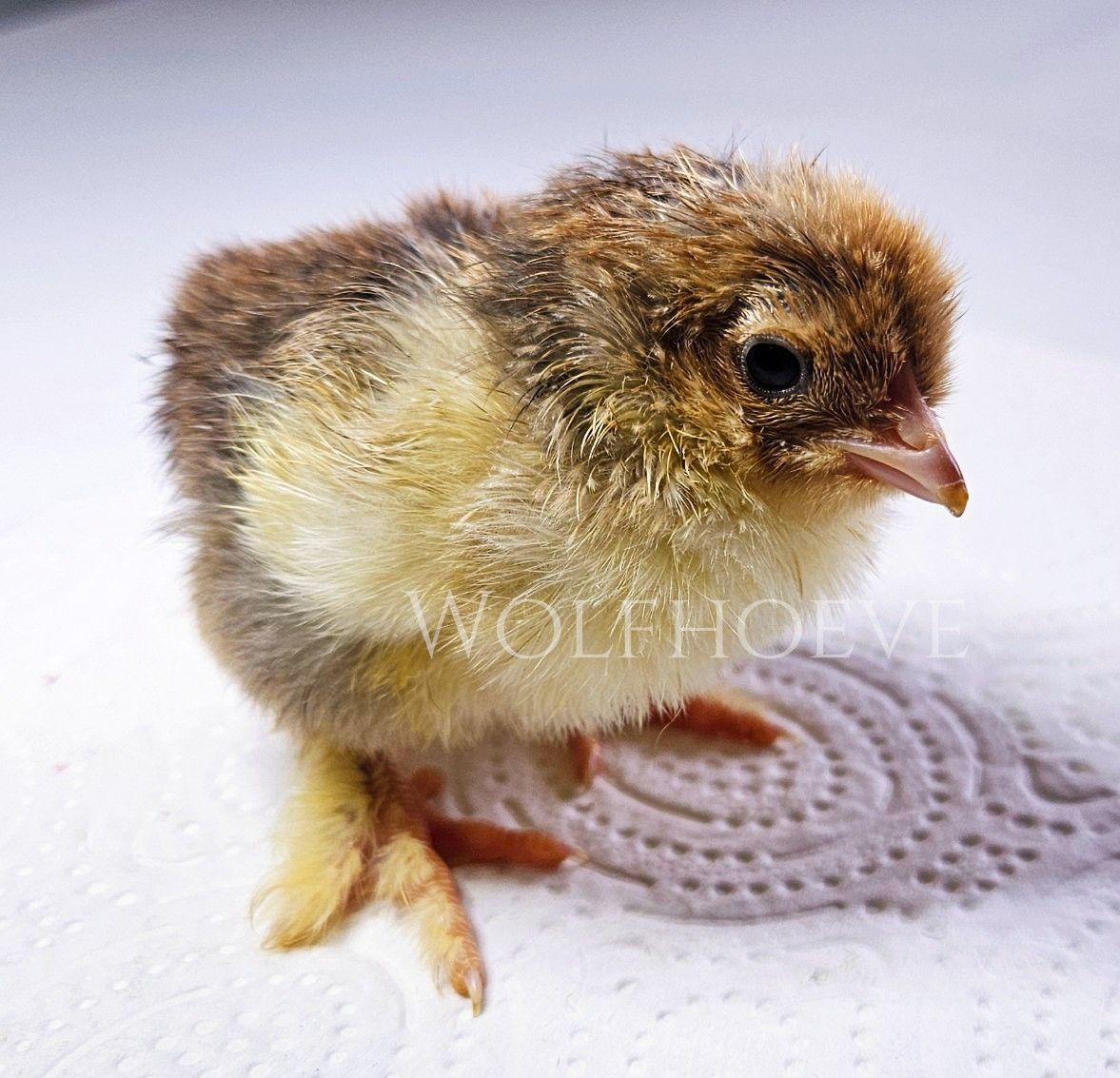
Two bases, one silhouette
Both varieties below are called some form of "Buff Black Columbian": a buff/gold body with black confined to the neck, tail and wing tips by the Columbian gene. But the base each is built on is different, and the genotype required to get a fully clean body is different too:
| eb (Brown) base | EWh (Wheaten) base | |
|---|---|---|
| Extension genotype | eb/eb | EWh/EWh |
| Columbian | Co/Co | Co/Co |
| Pattern gene needed for a clean body? | Yes — Pg/Pg as well, or pencilling ghosts persist | No — Columbian alone is enough |
| Undercolour | Grey | Buff |
The undercolour is the one field-checkable difference that survives on the outside of an otherwise identical-looking bird: lift a body feather, and grey underneath means eb, buff (not grey) means EWh. Everything else — the buff ground, the black hackle/tail/wing-tip markings, the overall Columbian silhouette — can look the same either way.
Why they can look the same at all
The Extension locus has a whole series of alleles, not just two, ranked in a dominance order:
E > ER > EWh > e+ > eb
EWh (Wheaten) sits above eb (Brown) in that order, and both start out as gold/buff-ground bases with black confined by nature to the extremities rather than spread over the body — which is exactly the raw material the Columbian gene needs to work with. Columbian's own job (restrict black to hackle, tail and wing tips) is largely the same operation on either base, so the finished silhouette converges even though the two starting alleles are not the same allele, and are not even close together in the dominance order.
Where it stops being cosmetic: crossing the two
The dominance order above is not just trivia — it decides what a cross between the two bases actually produces, and it is where a breeder who has only compared the two by eye can get a real surprise:
EWh is dominant over eb, an eb/EWh chick looks like the simpler, Wheaten-based parent — buff undercolour, no need for Pg to keep the body clean — while quietly carrying a hidden eb allele that contributes nothing visible to this generation at all.
The consequences show up a generation later, not immediately:
- The hidden allele resurfaces in F2. Breed two of those
eb/EWhF1 birds together (or back to anebbird) andeb/eboffspring reappear — birds that needPg/Pgto stay clean, even though neither visible parent in the F1 generation ever showed a hint of needing it. - A mixed base breaks the pattern gene, not just the ground colour. If
Pgis segregating anywhere in the mix, it lands on a genuinely mixedeb/EWhbird at some point — and pattern genes need a clean, homozygous base to organise black properly. The Breeding Outcomes tool flags this directly: on a Wheaten base, "pattern gene present, but clean lacing or pencilling needs a homozygous brown (eb/eb) base — on a wheaten base the body pattern does not form properly." A mixed-base bird can carry Pg and still fail to show a clean pattern. - Selecting purely by eye compounds the problem. Since the two bases converge on the same look, a breeder culling only on appearance has no way to tell a clean
EWh/EWhbird from a carriereb/EWhone without either checking undercolour or test-breeding — so an accidental mixed-base line can persist for several generations before it becomes visible.
None of this is unique to Buff Columbian — it is a general property of the Extension allele series, worked through here with one concrete pair because the resemblance is so close it makes the point vivid. Any two varieties built on adjacent E-series alleles with a similar-acting modifier layered on top can converge the same way.
Related
- See Buff Columbian genetics for the full
eb-based variety, including how the Blue locus turns it into Blue and Splash Buff Columbian. - See the Extension locus section of the Genetics Guide for the complete allele series and dominance order.
- See Pattern genes for why
Pgneeds a homozygous base to organise black cleanly, and what happens when it doesn't.
Check your own pair directly with the Compare tool, or run the actual cross — including what shows up in F2 — in Breeding Outcomes.
- Extension (
E) allele series and dominance order (E > ER > EWh > e+ > eb): Smyth JR Jr (1990) Genetics of plumage, skin and eye pigmentation in chickens, in Crawford RD (ed.) Poultry Breeding and Genetics, Elsevier — see the Genetics Guide references for the full citation and allele table.