Pattern genes organise black — they don't create it
The pigment is already there: the Extension base sets how much eumelanin (black) a bird has and where it starts. Pattern genes then arrange that black into shapes. The four that do most of the work are:
- Pattern gene (
Pg) — the organiser; on its own it breaks black into pencilling, and in combination it produces lacing, barring and spangling. - Columbian (
Co) — clears black off the body and confines it, which turns diffuse black into a defined edge. - Melanotic (
Ml) — adds black, which is what turns single lacing into double. - Dark brown (
Db) — restricts black differently again: withPgit lays the black across the feather as bars rather than around its edge, and withMlalongside it draws that black up into a tip spangle.
None of these means anything fixed on its own. The same Pg gives a completely different bird depending on which base and partners it has — so you cannot read it in isolation.
The same gene, eight outcomes
Here is the dependence laid out. Read it as "this combination → this pattern":
| Pattern | Combination | Look |
|---|---|---|
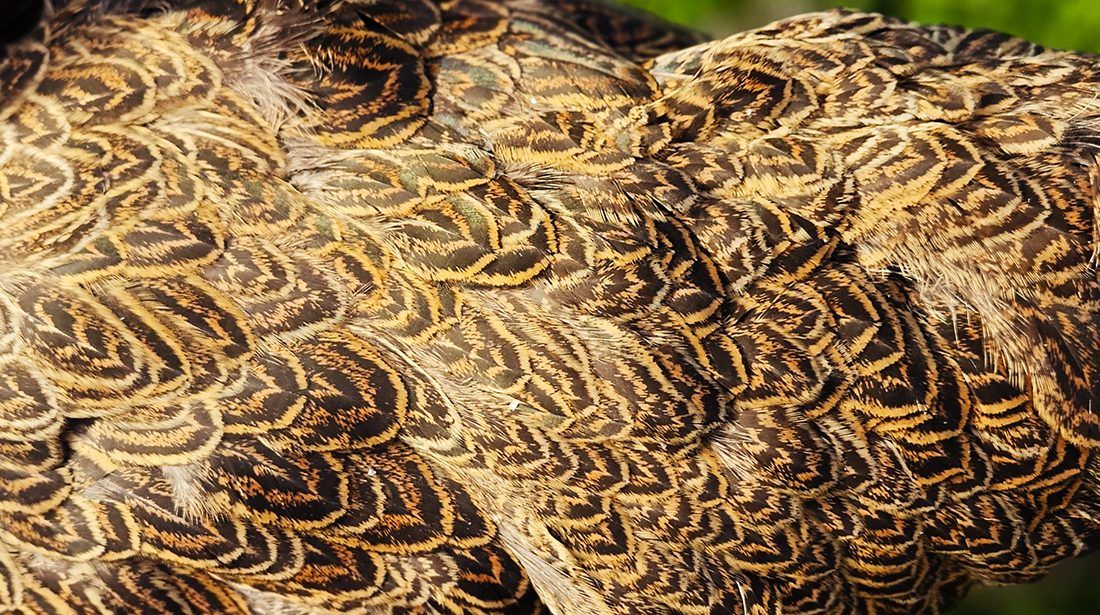
| Pencilling | eb + Pg/Pg, on its own | Fine concentric lines across each feather, clearest on hens. |
| Autosomal barring | eb + Pg/Pg + Db/Db (no Melanotic) | Black laid across the feather as transverse bars; the rooster keeps a black tail. |
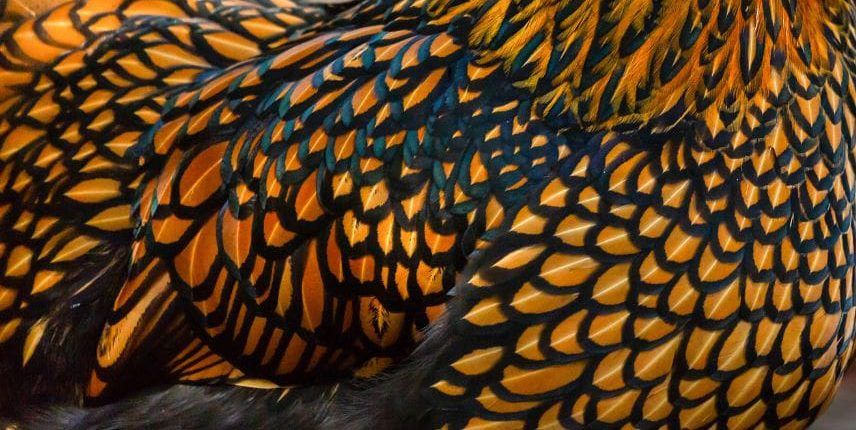
| Double lacing | eb + Pg/Pg + Ml/Ml (no Columbian) | Two concentric borders — the extra black from Melanotic. |
| Single lacing | eb + Pg/Pg + Ml/Ml + Co/Co | A clean dark border around a feather of ground colour. |
| Spangling | eb + Pg/Pg + Ml/Ml + Db/Db | Black gathered toward the feather tip rather than into a continuous ring. |
| Transverse pencilling | ER (birchen) + Pg/Pg + Db/Db (no Melanotic) | Finely barred across the feather; the rooster keeps a patterned tail, which is the birchen giveaway. |
| Spangling, birchen | ER + Pg/Pg + Db/Db + Ml/Ml | A dark spangle at each feather tip. One copy of Ml instead of two gives the crescent spangle. |
| Lacing, birchen | ER + Pg/Pg + Db/Db + Ml/Ml + Co/Co | The spangled set with Columbian added, pulling black into a ring at the edge. |
Swap the base under a fixed Pg and the pattern changes; add or remove Co, Ml or Db and it changes again. The two spangling rows are the clearest case: the same three partners — Pg, Ml, Db — give a tip spangle on either base, and on the birchen base it is Ml alone that separates that spangle from the transverse pencilling the same genes give without it. Lacing is really "Pattern gene, restricted to the edge by Columbian, on a brown base" — spell out the parts and the finished bird stops being mysterious. (Note that the autosomal barring the Pattern gene can produce is a separate thing from the sex-linked Barring gene, B, which lays the crisp cuckoo bars and is inherited on the Z chromosome.)
/Pg or /Ml shorthand above always means two copies (homozygous) — that's what a clean, complete pattern needs. One copy of Pg alone tends to give incomplete, patchy marking rather than full rings or bars; one copy of Ml on an otherwise-lacing base tends to leave the lacing incomplete too, often only at the feather tip. Columbian behaves a little differently: one copy clears black more strongly in roosters than in hens, and two copies are normally needed for an even pattern in both sexes. The Breeding Outcomes tool spells out which of these apply to a specific cross.
Pg has no single "look" of its own — its result is decided by the Extension base and by Co/Ml alongside it. This is why two birds can both "carry the pattern gene" and look nothing alike, and why building a laced variety means assembling several genes in the right combination, not flipping one switch.
Building a patterned variety
Because a pattern is a combination, creating or fixing one is a multi-locus project: you need the right base and the right pattern partners, several of them homozygous at once. A single cross rarely lands the whole combination; the pattern usually assembles over generations as the pieces come together. Laying out which loci differ between your birds — and what a cross will actually combine — is exactly what the tools are for: Compare Standards shows which loci separate two varieties, and Breeding Outcomes works out what a mating combines, including the linked Db–Ml–Pg group.
Individual pattern terms — lacing, pencilling, spangling, barring, and the genes behind them — are defined in the glossary.
- Pattern-gene combinations and the Extension base framework: Smyth JR Jr (1990) Genetics of plumage, skin and eye pigmentation in chickens, in Crawford RD (ed.) Poultry Breeding and Genetics, Elsevier.
- The
Dbroutes — autosomal barring fromPgwithDb, and the tip spangle onceMljoins them — rest on theDb/Mllinkage work cited on the linked genes page. - Molecular mapping of the linked
Db/Mlpattern loci on chromosome 1: Schwochow D et al. (2021) Pigment Cell & Melanoma Research; Sandve SR et al. (2021) PNAS. Full list in the Genetics Guide references.