eb/eb · Co/Co · I/i+. That hobby name is widely used and fine to search — but it isn't genetically precise, which is worth explaining properly. It's also easy to confuse with Splash Buff Columbian, a genuinely different variety built from a different gene (Blue/Splash, not Dominant White) — see that page for the distinction. For the wider system, see the Genetics Guide.
The genes that build it
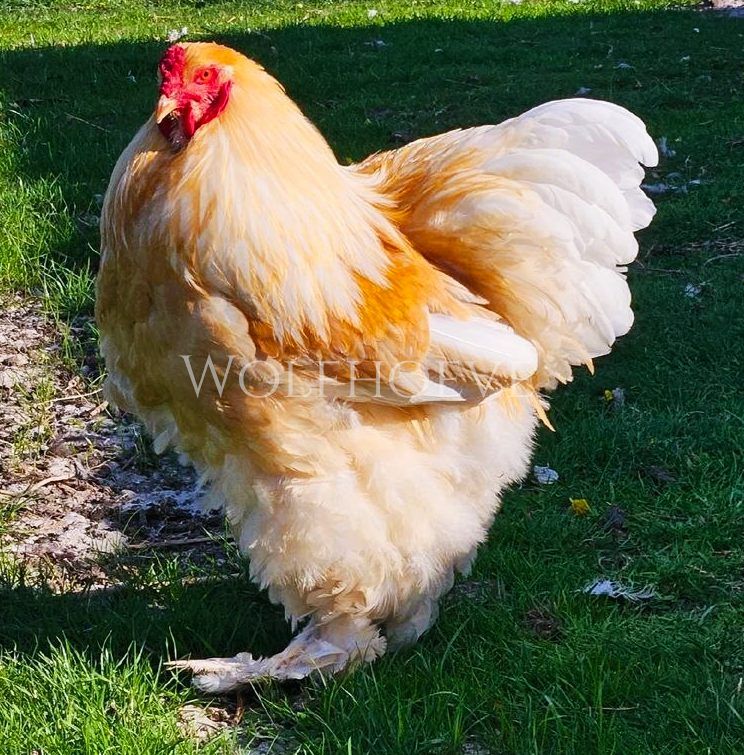
Buff White Columbian is a Columbian-patterned bird on a brown (eb) base, with its black neck and tail markings replaced by dominant white:
| Gene | Genotype | What it contributes |
|---|---|---|
| Extension — brown | eb/eb | The buff/gold ground colour, with grey (not white) undercolour. |
| Columbian | Co/Co | Restricts black to the neck, tail and wing tips, keeping the body buff. |
| Dominant White | I/i+ | Replaces what would otherwise be black Columbian markings with white.1 |
The result: a buff body with white (rather than black) neck and tail markings — hence "buff white Columbian," and, informally, "lemon pyle."
Why "lemon pyle" isn't technically pyle
True Pyle is a specific, older genotype: dominant white (I/i+) laid over a duckwing/Black-Breasted-Red base (e+) — the same base as a wild-type gold or silver partridge. Dominant white replaces the duckwing's black with white, while the gold areas remain, giving the classic white-and-gold Pyle look.2
| Variety | Genotype | Base |
|---|---|---|
| True Pyle | e+/e+ · I/i+ | Duckwing (Black-Breasted-Red) base — the traditional, technically correct Pyle. |
| Buff White Columbian ("lemon pyle") | eb/eb · Co/Co · I/i+ | Brown/Columbian base, not duckwing — dominant white over a completely different foundation. |
e+) base specifically. Put the same gene on an eb/Columbian base instead and you get Buff White Columbian — a good-looking, legitimate variety in its own right, just not the same genotype as Pyle. The name "lemon pyle" survives because the two look superficially similar (white replacing black, buff/gold retained), not because they share a genotype.
Why Brahmas can't be true Pyle
This distinction has a well-known practical consequence: Brahmas cannot be genetically true Pyle. Brahma colour genetics can carry any Extension allele except the wildtype e+ — Light and Dark are built on the eb (brown) base with Columbian patterning added, and other recognised Brahma patterns draw on other non-wildtype alleles — but no recognised Brahma standard is built on the e+ duckwing base that true Pyle requires.3 A "pyle" Brahma is, genetically, exactly this variety: dominant white over an eb/Columbian foundation — a Buff (or White) Columbian bird with the black replaced by white, not a true duckwing-based Pyle.
Breeders and Brahma specialists have long pointed this out from experience, and it's consistent with the breed's history: the Light and Dark Brahma patterns were developed from Asiatic partridge stock built on the eb base, with Columbian (Co) added afterward to produce the Light pattern4 — e+ was never part of that foundation. We haven't found a published genetics paper that states this as its own research finding; it's presented here as established breeder/expert consensus and as a direct consequence of the base genotype, not as a formally cited study.
How it breeds
Dominant white is, as the name says, dominant — a single copy (I/i+) is usually enough to produce the white replacement, though white can leak through as small black flecks unless I/I (homozygous) is fixed and clean-breeding lines are selected for. Crossing Buff White Columbian to a Buff Black Columbian (no dominant white) reintroduces the black Columbian markings in the offspring, since the ordinary black-marked form is the more "default" state without I layered on. You can test these crosses in the Breeding Outcomes tool.
- Dominant white (
Ilocus) is molecularly PMEL17 — see the white genetics page for the gene identity and how it differs from recessive white. - True Pyle's duckwing/dominant-white genotype and naming, and the Buff White Columbian ("lemon pyle") alias, match the Compare tool's standard data. Splash Buff Columbian is a separate, Blue/Splash-locus variety — see Buff Columbian genetics.
- No recognised Brahma colour pattern in the Compare tool's standard data is built on the wildtype
e+base; Light, Dark, partridge and related forms useeb, and other Brahma varieties use other non-wildtype Extension alleles, bute+does not appear in a Brahma standard in that data. - Smyth JR Jr (1990), in Crawford RD (ed.) Poultry Breeding and Genetics — see the Genetics Guide references for the general Extension/pattern-gene framework this history draws on.