Dominant White (I) — gene PMEL17
Dominant White (I) does its job with a single copy — it is dominant. Its gene is PMEL17, which builds the internal scaffold of the black-pigment granule; the mutation stops that scaffold forming, so eumelanin (black) fails to deposit.1 Two things are characteristic of it:
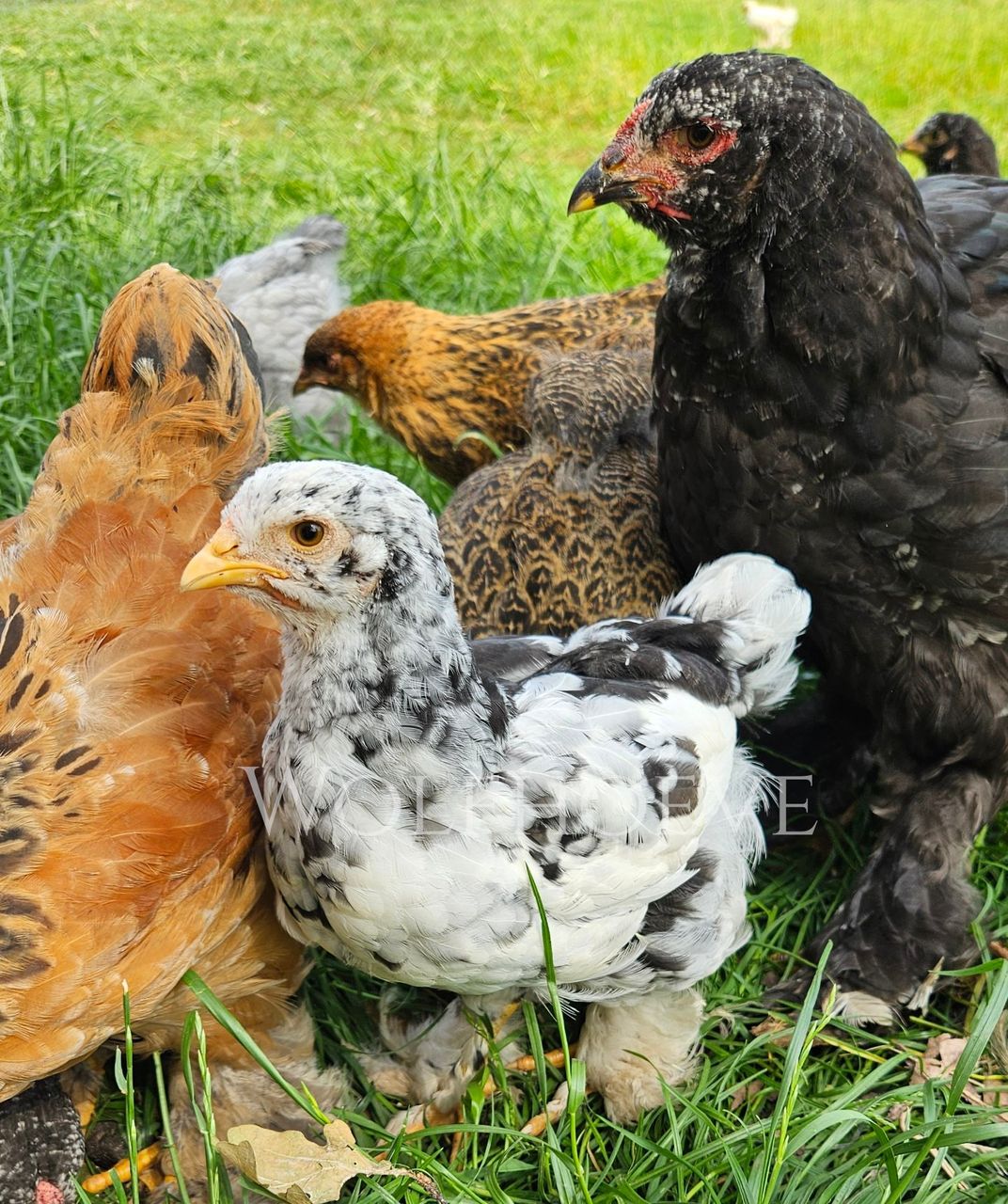
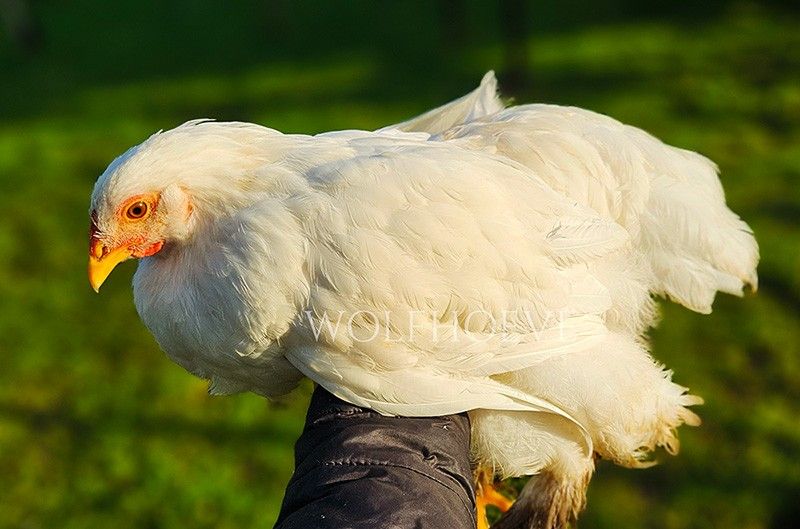
- It acts mainly on eumelanin (black). Pheomelanin (gold) is reduced but often leaks — this is why so many "white" birds carry flecks of red or gold in the hackle and shoulder.
- It leaves eye pigment normal, because PMEL17 is specific to the feather melanosome.
Layered over a Blue or Splash base, Dominant White is also the basis of the "Paint" pattern.
The same PMEL17 locus also carries the Dun allele (I^D) — a sibling of I, not a separate gene — which dilutes black to a warm grey-brown rather than whitening it; its homozygote (I^D/I^D) is Khaki. Being incompletely dominant, Dun follows the same one-copy/two-copy pattern as blue → splash (dun → khaki), so a locus-mate of Dominant White nonetheless leaves a coloured, non-white bird.1
Recessive White (c) — gene TYR (tyrosinase)
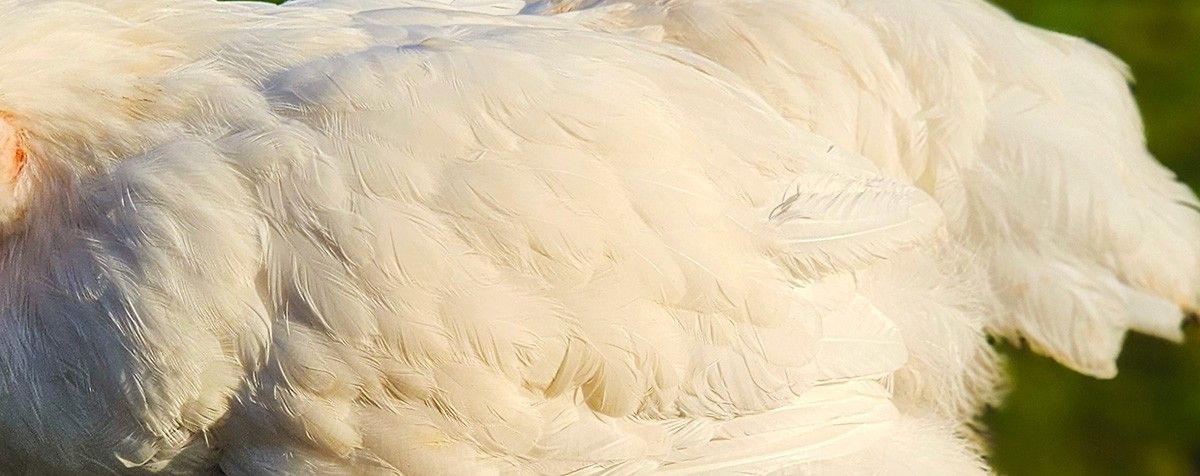
Recessive White (c) needs two copies (c/c) to show — a single copy is carried silently. It sits at a different gene entirely: TYR, tyrosinase, the enzyme at the very start of the pigment-making pathway. In recessive white a retroviral insertion in the tyrosinase gene suppresses its activity in the feather, so no pigment of either kind is laid down there.2 Because the block is at the source, recessive white tends to give a cleaner white with little or no leakage — though the eyes usually stay pigmented, since this allele affects the feather rather than switching tyrosinase off everywhere (that is a related allele in the same series, albinism).
Side by side
| Dominant White (I) | Recessive White (c) | |
|---|---|---|
| Gene | PMEL17 (melanosome protein) | TYR / tyrosinase (pigment enzyme) |
| Inheritance | Dominant — one copy shows | Recessive — needs two copies |
| Acts on | Mainly eumelanin (black) | All pigment at the source |
| Gold leakage | Common | Usually little to none |
| Carried hidden? | No — always visible | Yes — carriers look coloured |
Why two white birds can give coloured chicks
This is the trap the two genes set. Neither white erases the colour genes underneath — they only hide the result — so a white bird can be carrying a full colour genotype that its own white gene is masking. Put two whites together and the masks can come off:
- A Dominant White bird is often heterozygous (
I/i+) on a coloured base. A Recessive White bird (c/c) has colour hidden under it. Cross them and some chicks inherit neither white in a masking combination — and appear coloured. - Crossing recessive white × a coloured non-carrier gives an all-coloured F1 (every chick a carrier); recessive white then reappears in about a quarter of the F2.
Telling them apart
Without a test mating, the best visual clues are leakage and inheritance: a bird showing red or gold flecking on an otherwise white body is likely Dominant White (the leakage is its signature), while a consistently clean white that appeared only when two coloured-looking parents were crossed is likely Recessive White (it had been hidden in both carriers). A test cross to a known coloured bird settles it: Dominant White passes white to about half the chicks in one generation, whereas recessive white stays hidden until two carriers meet.
- Kerje S et al. (2004) The Dominant white, Dun and Smoky color variants in chicken are associated with insertion/deletion polymorphisms in the PMEL17 gene. Genetics 168:1507–1518.
- Chang C-M et al. (2006) Complete association between a retroviral insertion in the tyrosinase (TYR) gene and the recessive white mutation in chickens. BMC Genomics 7:19.