What colours do chickens come in?
There is no one "chicken colour" — a chicken's plumage is built from just two pigments, black-brown eumelanin and red-gold pheomelanin, arranged by around fifteen genes that between them produce several hundred recognised colour varieties across the breeds. They fall into a few families: solid colours (black, blue and splash, white, lavender, buff, chocolate); wild-type patterns (partridge and duckwing, salmon, wheaten); marked patterns (barred and cuckoo, laced, pencilled and spangled, mottled, mille fleur, porcelain); and restricted patterns where black is pushed to the neck and tail (Columbian and buff Columbian). The same gene can look very different depending on the base it lands on, which is why two birds with the same colour name are not always the same genotype. Browse every colour and pattern →
What colour will my chicken be when it grows up?
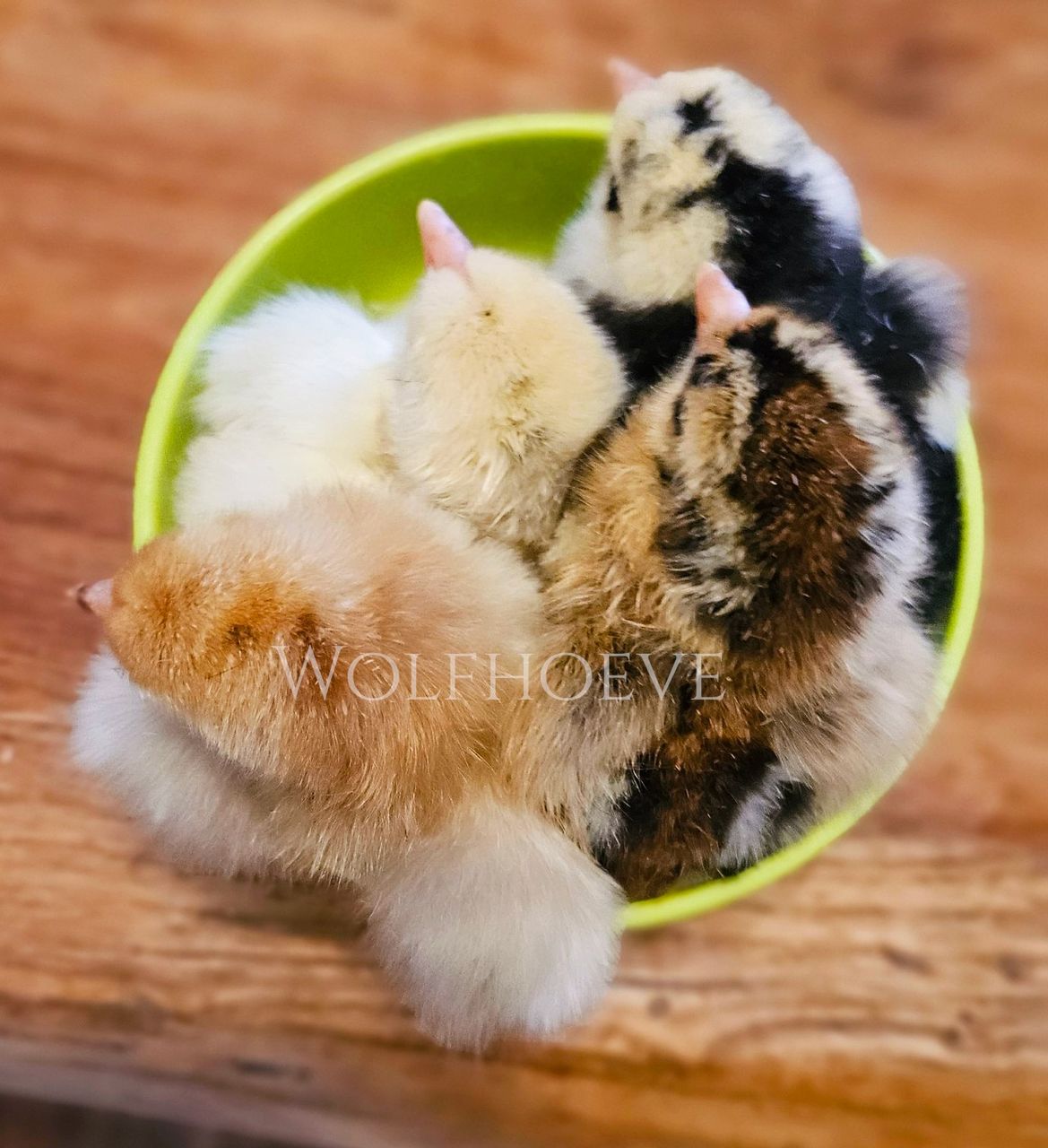
Its adult colour was fixed at fertilisation by the genes it inherited — but you often cannot read that colour off a chick. Down colour is a weak guide: several varieties are near-identical in down and only separate at the first juvenile moult, and a few genes keep changing the bird for longer than that. Mottling in particular adds more white at every moult, so a mottled bird is not finished until its second adult moult, and lavender is invisible in carriers entirely. If you know the parents, the Breeding Outcomes calculator gives the expected colours and their ratios; if you have the bird in front of you, the photo identifier will tell you which varieties its plumage matches.
How many chromosomes does a chicken have?
A chicken has 78 chromosomes — 39 pairs. Unusually for a vertebrate they come in two size classes: about ten pairs of large macrochromosomes and the rest tiny microchromosomes, which are gene-dense and were long hard to map. One pair is the sex pair, and in birds it works the opposite way round from mammals: the rooster is ZZ and the hen is ZW, so it is the hen who determines the sex of the chick. That asymmetry is exactly why some colour genes — Silver/Gold, Barring, Chocolate — are sex-linked, and why certain crosses let you sex chicks by their down colour at hatch.
What decides a chicken's leg and shank colour?
Leg colour runs on a different set of genes from plumage colour, which is why a black bird can have yellow, slate or willow shanks. Two things combine. First, skin colour: yellow skin is recessive (w/w, from carotenoids in the diet being deposited in the dermis), white skin is dominant (W). Second, dermal melanin — black pigment in the shank skin itself — which the sex-linked Dermal Melanin Inhibitor (Id) switches off when present. Put them together and you get the familiar combinations: yellow legs (yellow skin, no dermal melanin), white or pinkish legs (white skin, no dermal melanin), slate or blue legs (white skin plus dermal melanin), and willow or green legs (yellow skin plus dermal melanin). Because Id sits on the Z chromosome, shank colour can differ between sons and daughters of the same cross. See chicken anatomy for where the shank sits and what the surrounding parts are called.
What is the Extension (E) locus, and what do eb, E and the other e-alleles mean?
The Extension locus is the master control for the black/gold balance in plumage — its gene is MC1R.2 Rather than two alleles it carries a whole series, ranked from most to least dominant: E (extended black) > ER (birchen) > EWh (wheaten) > e+ (wild-type/duckwing) > eb (brown/partridge).1 Each sets a different starting distribution of eumelanin (black) versus pheomelanin (gold): E extends black over the whole body and suppresses gold; eb restricts black to feather edges so a gold-brown ground shows through — the common Partridge base; e+ is the ancestral duckwing. A bird carries two E-alleles and generally shows the higher-ranked one. So eb is not special — it is just one member of the series that happens to underlie many familiar partridge and laced varieties. Full walkthrough in the guide →
What is the difference between Splash and Paint chickens?
They can look similar but come from different genes. Splash is two copies of the Blue locus (Bl/Bl): Blue dilutes black with incomplete dominance, so one copy gives blue-grey and two copies give the pale, blue-flecked Splash. Paint is the Dominant White gene (I) — gene PMEL173 — layered over a Blue or Splash base; Dominant White inhibits eumelanin with a single copy. Because they reach a similar look by different routes, they breed very differently. The Compare Standards tool has a Splash vs Paint preset that puts both standards side by side.
What is the difference between the Lavender gene and the Blue gene?
Both lighten a bird, but they act on different pigments and inherit differently. Blue (Bl) is incompletely dominant and dilutes only eumelanin (black) — gold areas keep full colour; one copy blue-grey, two copies splash. Lavender (lav, also called self-blue) is recessive and dilutes both pigments evenly — pale grey where black would be, straw where gold would be; its gene is MLPH.4 The visual tell is the gold: full and bright on a Blue bird, washed-out on a Lavender bird. And because Lavender is recessive it travels hidden through carriers, whereas a single Blue allele is always visible. More in the guide →
What is the difference between Dominant White and Recessive White?
Both give a white bird, but they are unrelated genes that work oppositely. Dominant White (I) is dominant — a single copy inhibits eumelanin, gene PMEL173; it is also the basis of the Paint pattern over a Blue/Splash base. Recessive white (c) needs two copies to block pigment. Because the underlying genotype can be completely different, two white birds are not necessarily related in how they became white, and crossing them can produce coloured chicks. Full comparison on the white genetics page →
What are sex-linked genes in chickens?
Sex-linked genes sit on the Z chromosome. In chickens it is the female who carries two different sex chromosomes: roosters are ZZ, hens are ZW. So a hen carries only one copy of any Z-linked gene (she is hemizygous) and always shows whatever allele is on that single Z, while a rooster needs two recessive copies to show a recessive trait. The site's sex-linked loci are Silver/Gold (S, gene SLC45A25), Barring (B, gene CDKN2A/B6) and Chocolate (Choc, gene TYRP17). This asymmetry is what lets some crosses produce chicks that can be sexed by colour at hatch — see Sex-linked colour genes for the worked crosses, or the Genetics Guide.
Why do the Compare and Breeding tools sometimes show results separately for roosters and hens?
Most colour loci are autosomal, so sons and daughters inherit them the same way and one set of results covers both. But at sex-linked loci (Silver, Barring, Chocolate — see above) a hen receives only one Z chromosome, from her father, while a rooster receives one from each parent — so offspring ratios genuinely differ by sex there. The Breeding Outcomes tool shows genotype frequencies on a rooster basis and adds a note wherever a cross involves a sex-linked gene, because for those genes "half the offspring" is not the same statement for sons as for daughters.
What is a Punnett square, and what do F1 and F2 mean?
A Punnett square is a grid of every allele combination two parents can pass on, used to read off the expected genotype ratios of a cross. F1 is the first-generation offspring of two parents; F2 is the next generation, from crossing two F1 birds together or an F1 back to a parent. F2 is where recessive traits hidden in the F1 can reappear, which is why breeding projects plan out to F2 rather than judging a cross from the F1 alone. The Breeding Outcomes tool builds the squares and the F1/F2 frequency tables for you.
How many eggs do I need to hatch to get a certain number of chicks of one genotype?
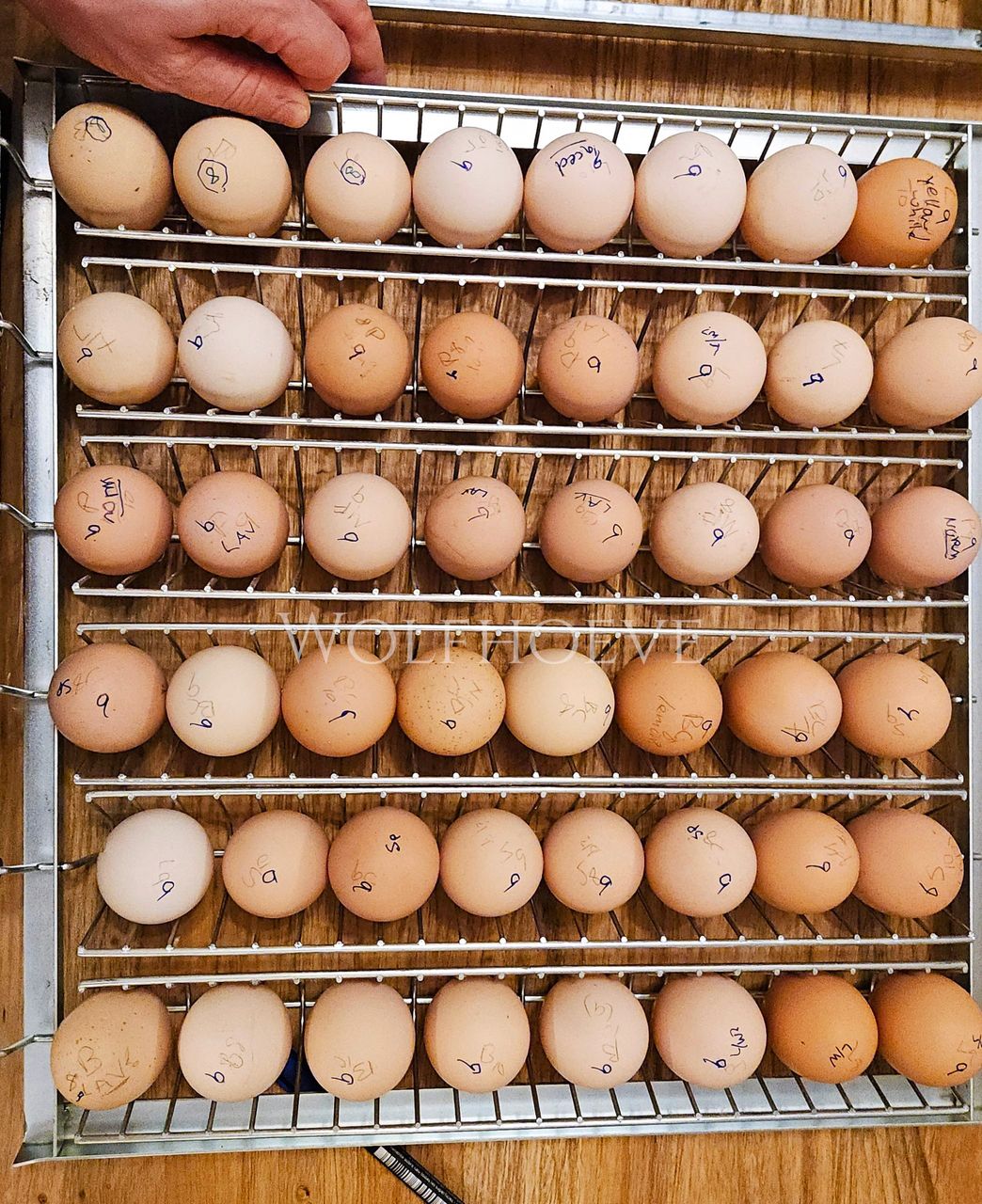
As a planning estimate, divide the number of chicks you want by that genotype's expected frequency from your cross. A genotype expected at about 9.8%, for example, needs roughly 100 hatched eggs to expect around 10 chicks of it. Real hatches vary around the expected ratio, so treat it as a target, not a guarantee. The Breeding Outcomes genotype frequency table has a calculator for this: tick the genotype rows you want, enter how many chicks you need, and it works out roughly how many eggs to plan to hatch.
Should I use "color" or "colour" when searching this site?
Either — the site and its tools use both spellings interchangeably and search is not spelling-sensitive. "Colour" appears more in the body text for an international breeder audience, while "color" is in the site name and some labels. There is no separate content for each spelling.
What references inform the genetics and colour descriptions on this site?
Colour descriptions and categorisation are informed by chicken-colors.info, a comprehensive, publicly accessible specialist reference that itself builds on the Dutch Kippenencyclopedie and the scientific literature. Variety photographs are credited to and linked back to the same site. Genotype associations draw on and are checked against the established calculator reference at kippenjungle.nl. The genetics explained here also draws on published scientific literature; specific molecular claims are cited in the Genetics Guide. Chicken Color Standards builds its own interactive tools and an evolving model on this reference foundation, combining genetic components into calculated outcomes and connecting recognised genotypes back to named phenotypes.
Does this site store my breeding data, photos, or search history?
No account exists. Compare Standards and Breeding Outcomes calculate results live for each request and do not save your inputs, uploaded calculator screenshots, or comparison history anywhere. Breeding Outcomes also lets you optionally save named birds and clans for convenience — these are kept only in your own browser on your device, never reach our servers, are not shared, and are removed when you clear your browser data. The one exception: if you choose to enter your email address to be notified about new features, that email address is stored on our server so we can contact you — it is never shared and used for nothing else.
- Smyth JR Jr (1990) Genetics of plumage, skin and eye pigmentation in chickens. In: Crawford RD (ed.) Poultry Breeding and Genetics. Elsevier — the Extension (E) allele series and dominance order.
- Kerje S, Lind J, Schütz K, Jensen P, Andersson L (2003) Melanocortin 1-receptor (MC1R) mutations are associated with plumage colour in chicken. Animal Genetics 34:241–248.
- Kerje S et al. (2004) The Dominant white, Dun and Smoky color variants in chicken are associated with insertion/deletion polymorphisms in the PMEL17 gene. Genetics 168:1507–1518.
- Vaez M et al. (2008) A single point-mutation within the melanophilin (MLPH) gene causes the lavender plumage colour dilution phenotype in the chicken. BMC Genetics 9:7.
- Gunnarsson U et al. (2007) Mutations in SLC45A2 cause plumage color variation in chicken and Japanese quail. Genetics 175:867–877.
- Hellström AR et al. (2010) Sex-linked barring in chickens is controlled by the CDKN2A/B tumour-suppressor locus. Pigment Cell & Melanoma Research 23:521–530.
- Li J et al. (2019) A missense mutation in TYRP1 causes the chocolate plumage color in chicken and alters melanosome structure. Pigment Cell & Melanoma Research 32:381–390.